

 Udemezue John
When you look at a map of the world, Cape Verde looks like a small cluster of dots sitting right next to the massive bulge of West Africa. Because of this, it is easy to think that they are exactly the same. Officially, Cape Verde is even part of the West African community.
But if you get on a plane and travel from the mainland to these islands, you will feel like you stepped into a completely different world. The landscapes change from thick forests and vast deserts to rocky volcanic peaks.
Make sure to subscribe to this article
The sounds change from bustling, high-energy mainland markets to relaxed island music with a European twist.
Understanding these differences helps us see how unique this part of the world truly is. Let us break down how mainland West Africa and Cape Verde differ in their geography, culture, daily life, and history.
The Big Picture: Where Are We Talking About?
Mainland West Africa is a massive region. It includes 16 countries, such as Nigeria, Ghana, Senegal, and Mali. It stretches across millions of square kilometers and is home to hundreds of millions of people.
Cape Verde, on the other hand, is an island nation. It is located in the Atlantic Ocean, about 570 kilometers west of the coast of Senegal. It consists of ten main islands and a few smaller islets. The entire population of Cape Verde is just over 500,000 people, which is smaller than many single cities on the mainland.
Geographic Differences: Vast Mainland vs. Volcanic Islands
The physical environment of these two areas could not be more different. The mainland offers massive scale and deep internal variety, while Cape Verde offers rugged, isolated island beauty.
The Landscape of Mainland West Africa
Mainland West Africa has almost every type of terrain you can think of.
In the north, you find the southern edges of the Sahara Desert. This area is dry, sandy, and hot.
As you move south, the desert turns into the Sahel, a dry grassland.
Further south, the land becomes green and lush. You will find tropical rainforests, large river systems like the Niger River, and long stretches of sandy Atlantic coastline.
Because the mainland is so large, you can drive for days and see the environment change completely outside your window.
The Landscape of Cape Verde
Cape Verde does not have deserts or rainforests. Instead, these islands were formed by ancient volcanoes.
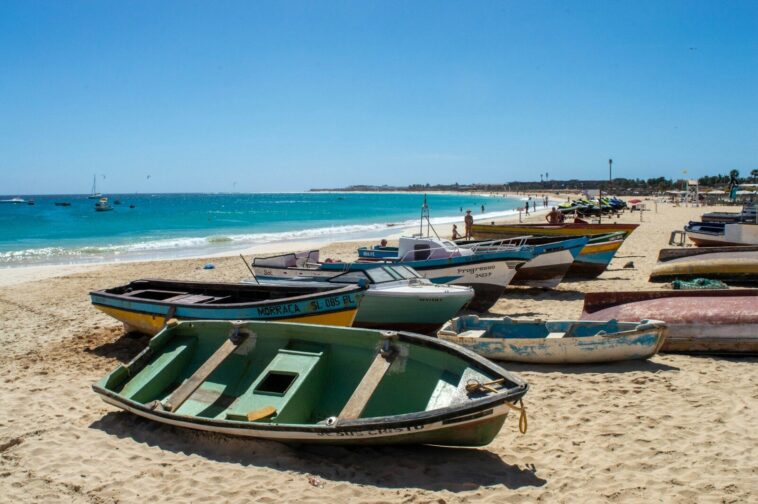
The islands are divided into two main groups based on the wind blows. Some islands are flat, dry, and sandy. Islands like Sal and Boa Vista look almost like deserts floating in the ocean, and they are famous for their long white beaches.
Other islands are incredibly rocky and mountainous. Islands like Santo Antão and Fogo have giant volcanic peaks, deep valleys, and dramatic cliffs. Fogo even has an active volcano that you can climb.
Water is very scarce in Cape Verde. Unlike the mainland with its massive rivers, Cape Verde has no permanent rivers, and it does not rain very often.
Quick Geography Comparison
| Feature | Mainland West Africa | Cape Verde |
| Land Type | Massive continental landmass | Group of 10 volcanic islands |
| Climate | Ranges from super dry desert to wet rainforest | Mostly dry, windy, and mild year-round |
| Water Sources | Huge rivers (Niger, Senegal) and lakes | Very limited fresh water, mostly relies on desalination |
| Major Terrain | Flat savannahs, thick forests, desert dunes | High volcanic mountains, rocky cliffs, sandy beaches |
Cultural Differences: Deep African Traditions vs. Unique Creole Identity
The cultural divide between the mainland and Cape Verde is perhaps even bigger than the geographic one. It comes down to history and the way people live.
Culture on the Mainland
Mainland West Africa is a beautiful fabric made of thousands of different ethnic groups. In Nigeria alone, there are over 250 ethnic groups, including the Yoruba, Igbo, and Hausa. Senegal is home to the Wolof, and Ghana is famous for the Ashanti.
Each of these groups has its own ancient language, traditional clothing, and customs. People take great pride in their ancestral roots. You will see people wearing bright, beautiful traditional fabrics like Ankara or Kente cloth.
While English, French, and Portuguese are used for official business due to colonial history, hundreds of local languages are spoken every single day in the streets.
Culture in Cape Verde
Cape Verde has a completely different cultural story. Before the 1400s, nobody lived on these islands. They were completely empty.
When Portuguese sailors arrived in 1456, they settled the islands and brought enslaved people from the West African mainland. Over hundreds of years, the European settlers and African populations mixed.
This created a brand-new, unique culture known as Creole or Mestiço.
Cape Verdean culture is not purely African, and it is not purely European. It is a distinct blend of both.
People in Cape Verde do not dress in traditional West African fabrics like Kente cloth. Their style is more westernized.
The official language is Portuguese, which is used in schools and government. However, the language of the heart is Cape Verdean Creole (Crioulo). This is a language based on Portuguese but heavily influenced by West African grammar and words. Everyone speaks it at home and in the streets.
Daily Life, Food, and Vibe
The daily rhythm of life feels very different depending on whether your feet are on mainland soil or island sand.
Food on the Mainland vs. Cape Verde
Food tells the story of these two places perfectly.
On the mainland, food is often fiery, spicy, and based on crops grown in the rich soil. You will eat a lot of:
- Jollof Rice: A famous, spicy one-pot rice dish.
- Fufu or Pounded Yam: Starchy sides used to scoop up thick soups.
- Peanut Stews: Rich and savory sauces made with meat and vegetables.
In Cape Verde, the food is much milder. They do not use hot peppers the way people do in Nigeria or Ghana. Instead, the national dish is Cachupa. This is a slow-cooked stew made of corn, beans, cassava, and sweet potatoes. If it is a special occasion, they add sausage, pork, or fish.
Because Cape Verde is surrounded by ocean, fresh seafood like tuna, lobster, and octopus is a huge part of the daily diet.
The Pace of Life
If you visit a major mainland city like Lagos in Nigeria or Accra in Ghana, the energy is electric. It is fast, loud, crowded, and full of hustle. People are always moving, trying to make things happen.
Cape Verde is famous for a phrase you will see written everywhere: “No Stress.”
The pace of life here is slow and relaxed. People take their time. The evenings are spent walking along the beach or sitting in quiet squares listening to live music.
The music itself reflects this vibe. While the mainland is famous for high-energy Afrobeats that makes you want to dance wildly, Cape Verde is famous for Morna. This is a slow, soulful, and melancholic type of music made famous by the singer Cesária Évora. It sounds more like Portuguese Fado or the blues.
Why Do These Differences Exist?
To understand why they are so different, we have to look back at history.
Mainland West Africa had massive, powerful empires long before Europeans ever arrived. The Mali Empire, the Kingdom of Benin, and the Ashanti Empire had complex systems of government, trade routes, and deep artistic traditions. European colonization changed things, but it did not wipe out the ancient cultures and deep roots of the people.
Cape Verde had no ancient empires because it had no people. The culture started from scratch on those empty islands in the 15th century. Because the islands were a central hub for the transatlantic slave trade and Portuguese shipping routes, the mix of cultures happened in isolation from the rest of Africa.
This isolation allowed Cape Verde to develop a specific national identity that looks outward toward both Africa and Europe.
Frequently Asked Questions (FAQs)
Is Cape Verde considered part of Africa?
Yes, Cape Verde is geographically and politically part of Africa. It is a member of the African Union and the Economic Community of West African States (ECOWAS). However, culturally and physically, it feels very different from the mainland.
Do I need a different currency for Cape Verde?
Yes. While many countries in French-speaking West Africa use the CFA Franc, and Ghana uses the Cedi, Cape Verde uses its own currency called the Cape Verdean Escudo (CVE). It is pegged directly to the Euro.
Which place is easier for English speakers to visit?
Mainland countries like Ghana, Nigeria, and Sierra Leone use English as their official language, making communication very easy for English speakers. In Cape Verde, English is spoken in tourist resorts, but you will find that Portuguese and Creole are the main languages spoken by locals.
Is the weather the same in both places?
Not exactly. Mainland West Africa can get incredibly humid and hot, especially in the southern coastal and forest regions, or extremely hot and dry in the north. Cape Verde has a much milder, temperate climate. It is breezy, less humid, and stays warm but comfortable for most of the year.
Conclusion
Mainland West Africa and Cape Verde share a geographic region and important historical ties, but they are worlds apart.
The mainland is a massive, high-energy powerhouse filled with thousands of years of tribal history, diverse ecosystems, and rich traditions.
Cape Verde is a peaceful, poetic cluster of volcanic islands where African and Portuguese roots have grown together into a unique Creole culture.
Neither one is better than the other; they simply offer two entirely different ways of experiencing this corner of our planet.
Have you ever visited a place that felt completely different from its neighboring countries on the map? Let us know your thoughts in the comments below!

GIPHY App Key not set. Please check settings